Your videos in other languages. Every speaker keeps their own voice.
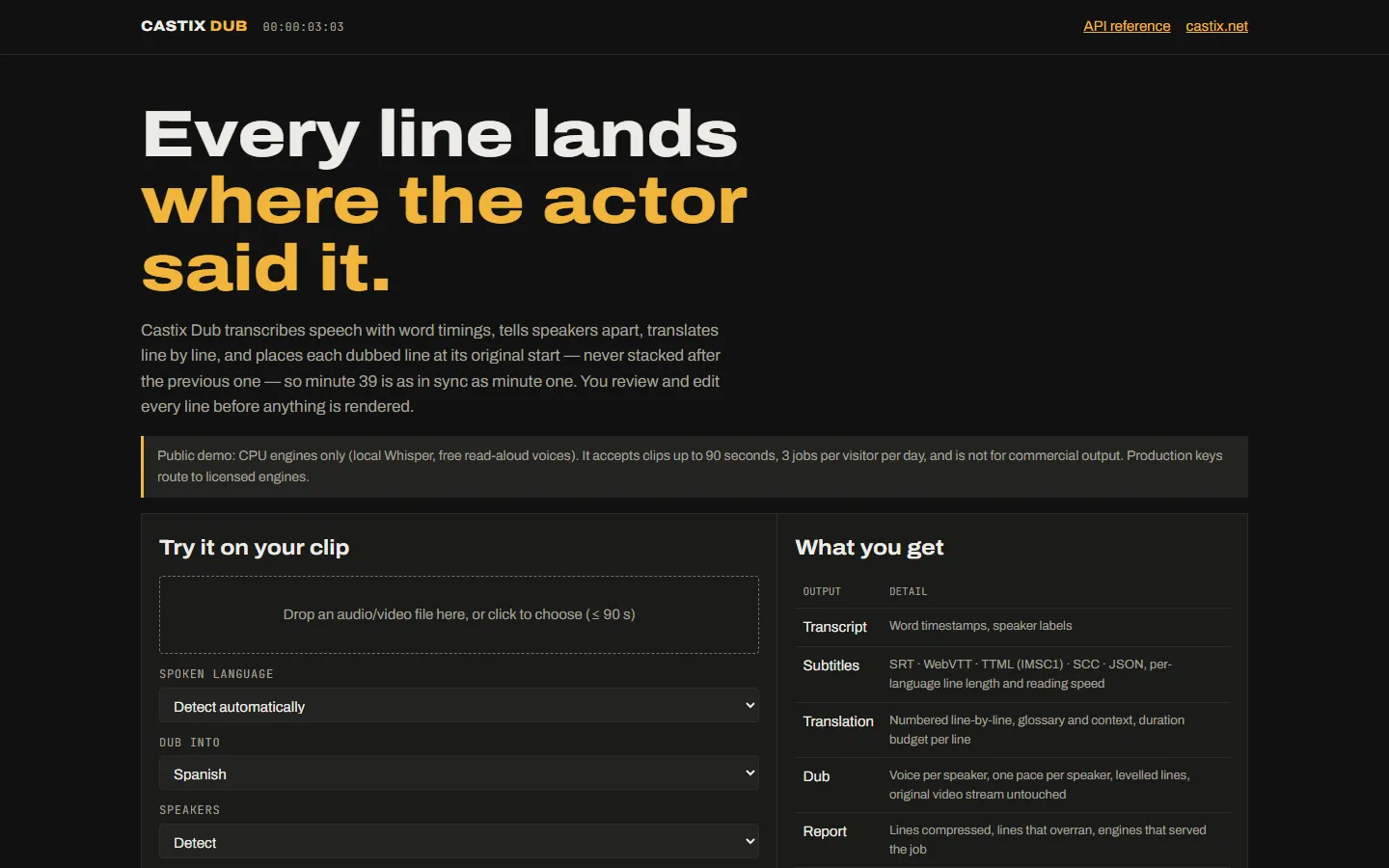
Upload a video. Dub writes the subtitles, translates them, and gives each person on screen their own voice in the new language, starting exactly when they start talking.
Status: The engine runs in production in a consumer dubbing service today. Castix Dub, the international API built on it, is in development.
Subtitles in minutes
Accurate subtitles in the right length and reading speed for each language.
A voice per speaker
Dub hears who is talking and gives each person a matching voice.
On time, every line
Each line starts when the original line started, so minute forty is as in sync as minute one.
Your own voices, with consent
Optionally keep the speakers' own voices, only with their recorded permission.
Who it is for: Broadcasters, streaming services, course creators and companies with video for several countries.
Listen in your language
An original clip and its dub into the language of this page. Outputs are unedited.
Demo voices are free Microsoft Edge read-aloud voices (not licensed for resale); production uses licensed voices. Translation written by people in the review step. Music generated for this demo.
Three ways to buy
Rent it
We run it for you, in the region you choose. You pay monthly and get support.
Run it on your servers
An annual licence to install it in your own building or cloud. Your videos never leave your network.
Own the code
You buy the full source code with documentation and a handover from the engineers who wrote it.
The technical detail
For your engineers: what it does exactly, how it is built, the numbers we measured and how it compares.
What it does
Transcribe, subtitle, translate and dub with a voice per speaker, placed at the original timing. Voice cloning only with recorded consent.
Transcription
Speech to text with word timing, ready for subtitles, search and compliance.
Subtitles
SRT, WebVTT and ASS, or burned into the picture, with line rules of 42 characters, two lines and 17 characters per second.
Translation
Translate subtitles and scripts before voicing, including right-to-left languages such as Arabic.
Speaker detection
Finds how many people speak and who says what, then picks a voice for each one by gender and pitch.
Timing-locked dubbing
Each line is placed at its absolute original time. Speech can be sped up to 1.35× at most, never slowed, and overflows are reported.
Clean finishing
The original audio is ducked under speech, the mix is loudness-normalised in two passes and the video stream is copied without re-encoding.
Consented voice cloning
Optional cloning of a speaker's own voice with recorded consent; the clone is deleted after the job.
On the roadmap: lip-sync, glossaries and more dub voices. Transcription accuracy is published per language as each Common Voice run completes.
How it works
Transcribe
Speech becomes timed text.
Find speakers
Voices are clustered and each speaker gets a cast voice.
Translate
Lines are translated and checked against timing.
Voice
Each line is spoken and placed at its original time.
Finish
Ducking, loudness and muxing; subtitles are exported.
Numbers, with their method
Every figure on this site comes from a run we can repeat. Where a number is a target, it says so.
MethodCommon Voice 17 test set, 50 clips, CPU baseline model. Other languages are being measured.
Method12 sentences, synthetic speech round-trip. A floor for clean audio, not a promise for noisy recordings.
MethodReal speech with music under the dialogue, after background subtraction.
MethodTwo-pass loudness normalisation, measured on output.
Specifications
| Languages | Transcription in 38 languages; dubbing voices in English, Arabic, Turkish, Persian, German, French, Spanish, Russian and Chinese |
|---|---|
| Subtitle formats | SRT, WebVTT, TTML (IMSC1), SCC, JSON, burn-in |
| Line rules | Per language, after the Netflix Timed Text Style Guides (e.g. 42 characters and 20 per second in English) |
| Timing | Absolute placement; compress only, up to 1.35×; overflow reported |
| Mix | Ducking 0.3 between lines, 0.05 under speech, 150 ms ramps; two-pass loudness to −16 LUFS |
| Job limits | Dubbing up to 20 minutes, transcription up to 2 hours per job |
| Voice cloning | Opt-in, recorded consent, at least 10 s of the speaker, deleted after use |
| Lip-sync | Roadmap |
How it compares
| Capability | Castix Dub | ElevenLabs | Rask.ai | HeyGen | Deepdub | Dubverse | Speechify |
|---|---|---|---|---|---|---|---|
| Transcription | Yes | Yes | Yes | Yes | Yes | Yes | Not verified |
| Published error rate by language | Yes | No | Not verified | Not verified | Partial | Not verified | Not verified |
| SRT, VTT, ASS and burn-in | Yes | Not verified | Partial | Partial | Not verified | Partial | Not verified |
| Multi-speaker dubbing | Yes | Yes | Yes | Yes | Yes | Not verified | Not verified |
| Timing-locked placement | Yes | Partial | Not verified | Not verified | Partial | Not verified | Not verified |
| Consent-gated voice cloning | Yes | Partial | Partial | Partial | Partial | Partial | Partial |
| Lip-sync | Roadmap | Not verified | Partial | Yes | Partial | Not verified | Not verified |
| On-premises | Yes | No | No | No | Not verified | No | No |
Competitor facts were checked on the vendors' own pages on 6 November 2026. Links are in our research notes. "Not verified" means we could not confirm it.
Licensing and pricing models
Prices depend on volume and deployment. We quote within two working days.
Per minute, per layer
Transcribe · subtitle · translate · dubPay only for the steps you need.
Minute bundles
MonthlyFor teams with steady volume.
Per-title package
Episode or featureFixed price for broadcast deliveries, including review.
Private deployment
Annual, per GPU nodeFor broadcasters and institutions that cannot send audio to a public cloud.
Questions buyers ask
How accurate is the transcription?
12.9% word error rate in English on 50 Common Voice clips with our CPU baseline model; production engines do better. We publish each language with its test as it completes.
Will the dub be out of sync?
Each line is placed at its original start time and is never stretched. If a line cannot fit even at 1.35×, the job report names it so an editor can shorten it.
How many speakers can it handle?
It detects the number of speakers and assigns a voice to each. With the speaker count given, labelling was 91% accurate on 72 real recordings.
Can you clone our presenter's voice?
Only with the presenter's recorded consent. The clone is used for the job and deleted afterwards.
Which subtitle formats do you export?
SRT, WebVTT, TTML, SCC and JSON, or subtitles burned into the picture.
Is there lip-sync?
Not yet. It is on the roadmap, and we will not claim it until it is measured.
Can we run it privately?
Yes, with a private deployment licence for your own GPU servers.