Make any film family-safe, for any country.
Guard watches a film for violence, nudity, weapons, drugs and bad language, shows a person every moment it found, and then blurs, cuts or bleeps what that person approves.

Status: In development, with a working review tool. Detection is a review assistant: it suggests, a person decides. Accuracy per category is published below as we measure it.
Finds the problem moments
Violence, nudity, weapons, drugs, alcohol, smoking and swearing, in the picture and in the dialogue.
A person decides
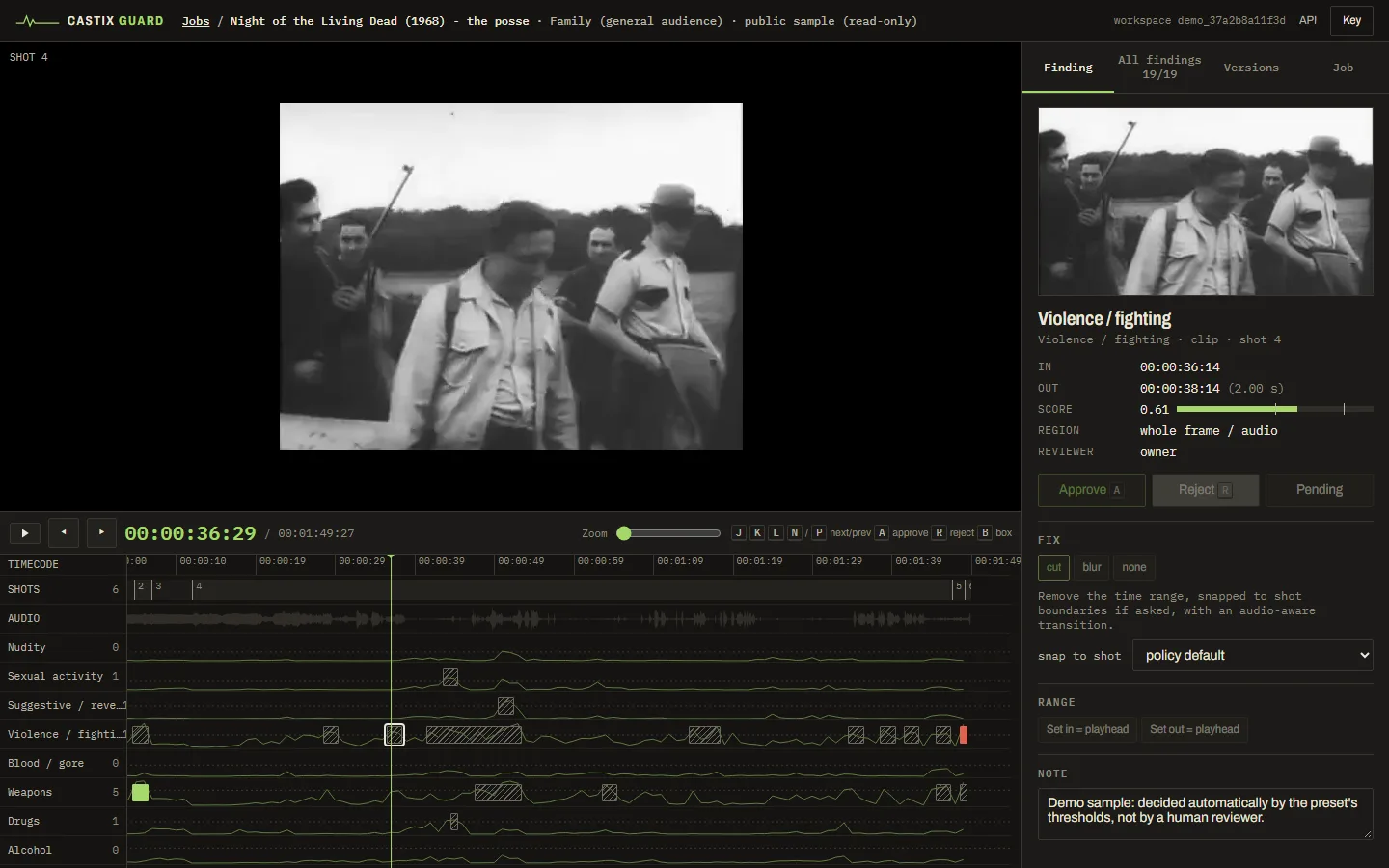
Every finding waits on a timeline for an editor to approve, change or reject. Nothing is cut on its own.
Fixes it properly
Blur, pixelate, cover, cut or bleep, frame-accurate, without touching the original file.
One rulebook per audience
Ready-made rules for families, children, airlines and different broadcast markets, all editable.
Who it is for: Broadcasters, streaming services and airlines that show the same film to different audiences.
Drag to compare: before and after
The same frame from Tears of Steel with the weapon blurred, pixelated or covered. Pick a fix and drag the handle.
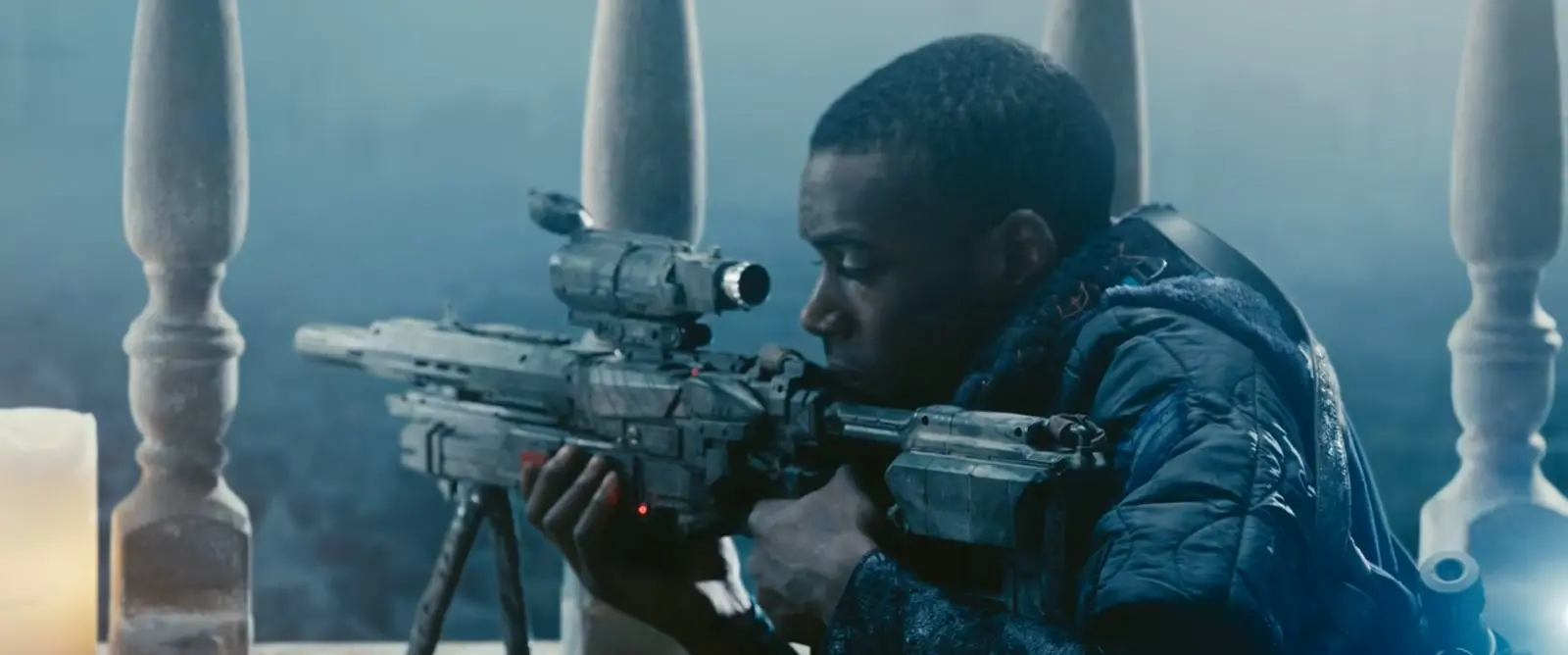
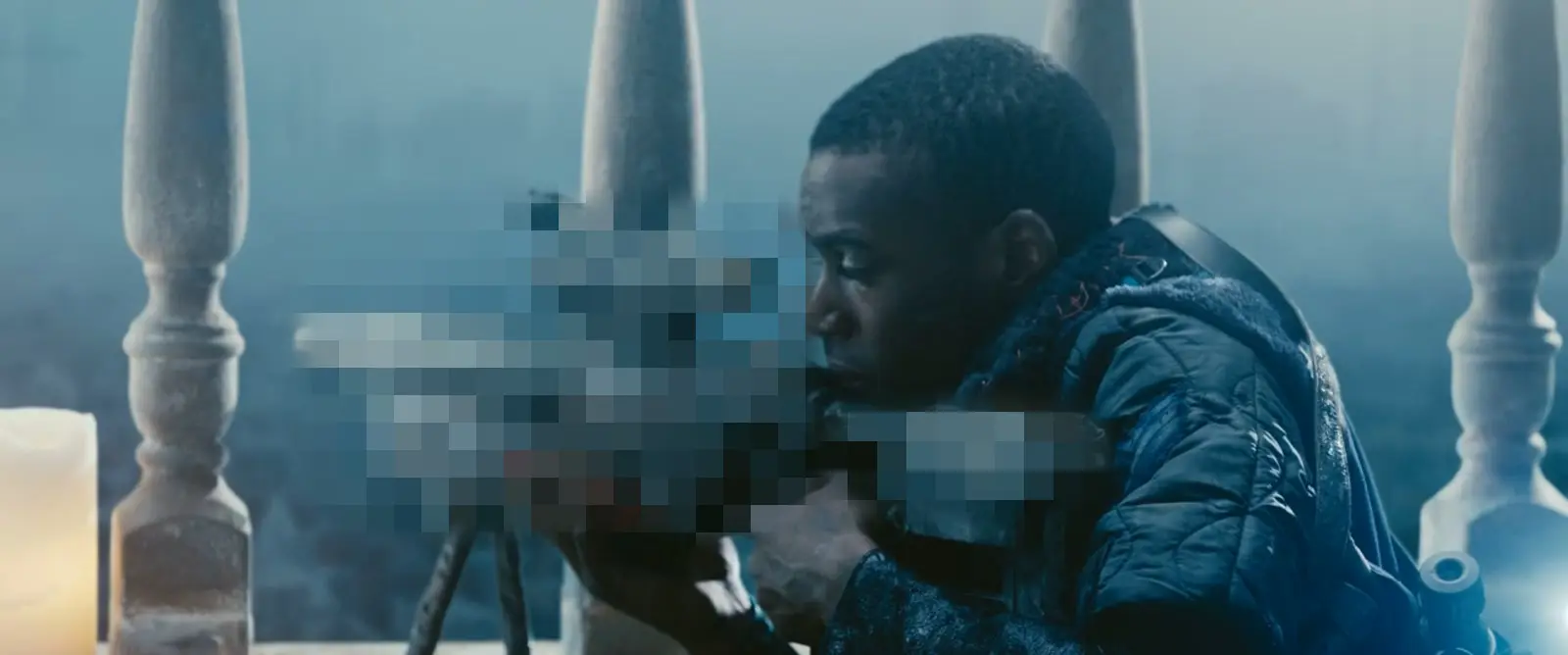 BeforeAfter: Pixelate
Three ways to buy
Rent it
We run it for you, in the region you choose. You pay monthly and get support.
Run it on your servers
An annual licence to install it in your own building or cloud. Your videos never leave your network.
Own the code
You buy the full source code with documentation and a handover from the engineers who wrote it.
The technical detail
For your engineers: what it does exactly, how it is built, the numbers we measured and how it compares.
What it does
Frame-accurate review for family-safe and market-specific versions. Guard finds what a market will not accept, puts it on a timeline for a human to approve and then fixes it: blur, mask, inpaint, crop, cut, bleep or mute.
Detect by category
Nudity, sexual content, intimacy, suggestive content, violence, gore, weapons, drugs, alcohol, smoking, spoken profanity and on-screen text, plus your own categories.
Policies per market
Ready-made rules for family, kids, airline and regional broadcast audiences, each with its own review and automatic thresholds. The kids rules block anything they are unsure about.
Findings timeline
Every finding sits on a shot-aware timeline with SMPTE timecode, including drop-frame, so a reviewer can jump, approve or change the fix.
Fix operators
Blur, pixelate, solid box, tracked mask, inpaint, crop, cut, replace, 1 kHz bleep with soft ramps, and mute.
GPU when it helps, CPU when it must
Masks and inpainting use SAM 2 and LaMa on a GPU provider; a CPU path (tracked ellipse, Telea inpainting) keeps demos and air-gapped sites working.
Back to your edit
Export an edit decision list and a compliance report per market, so the decision trail survives into your NLE and your archive.
On the roadmap: live-stream review, NLE round-trip plug-ins, rating certificates per regulator once validated with each regulator.
How it works
Ingest
Drop a master or point Guard at a watch folder.
Detect
Shots are split, frames and audio are scanned against the policy you chose.
Review
A reviewer approves, rejects or changes each finding on the timeline.
Fix
Guard renders blur, masks, inpainting, cuts and audio fixes frame-accurately.
Deliver
You get the clean master, an edit list and a compliance report.
Numbers, with their method
Every figure on this site comes from a run we can repeat. Where a number is a target, it says so.
MethodPolicy schema in the Guard engine.
MethodSynthetic 40-sentence test reel, word-level transcripts.
MethodFirst visual test set. Visual detection is early, which is why a person reviews every finding.
Specifications
| Categories | 12 built-in plus custom |
|---|---|
| Market presets | Family, kids, airline, regional broadcast (all editable) |
| Visual fixes | Blur, pixelate, box, tracked mask, inpaint, crop, cut, replace |
| Audio fixes | Bleep (1 kHz, 10 ms ramps), mute |
| Timecode | SMPTE, drop-frame and non-drop-frame |
| Compute | GPU providers behind one interface; CPU fallback |
| Exports | Clean master, edit decision list, compliance report |
| Live streams | Roadmap |
How it compares
| Capability | Castix Guard | Hive (Deploy) | AWS Rekognition | Sightengine | VidAngel / ClearPlay | Valossa |
|---|---|---|---|---|---|---|
| Visual detection | Yes | Yes | Yes | Yes | Partial | Yes |
| Spoken profanity | Yes | Yes | No | Partial | Yes | Yes |
| Custom policy | Yes | Yes | Yes | Yes | Partial | Yes |
| Findings timeline and review | Yes | Partial | Partial | Yes | No | Yes |
| Blur, mask and inpaint | Yes | No | No | No | No | Not verified |
| Crop, cut, bleep and mute | Yes | No | No | No | Partial | Not verified |
| Edit list export | Yes | No | No | No | No | Not verified |
| Report per market | Yes | No | No | No | No | Partial |
| On-premises | Yes | Not verified | No | Partial | No | Yes |
Competitor facts were checked on the vendors' own pages on 6 November 2026. Links are in our research notes. "Not verified" means we could not confirm it.
Licensing and pricing models
Prices depend on volume and deployment. We quote within two working days.
Per processed minute
Detection and reviewVolume tiers. Unlike detection-only APIs, review and the edit list are included.
Clean-master package
Per title or episodeDetection, review and rendered fixes for a fixed price, the way broadcasters and airlines budget.
Reviewer seats
Per reviewer, monthlyFor teams that review in-house.
On-premises
Annual, per GPU nodeFor unreleased masters that must not leave your building.
Questions buyers ask
How accurate is detection?
It depends on the category, and we publish each one with its test. Swearing in speech is already strong (94.4% precision, 85.0% recall on a synthetic test reel); visual categories such as weapons are early. That is why Guard is a review assistant: a person approves every fix.
Does a human stay in control?
Yes. Automatic thresholds are per policy, and anything below them goes to a reviewer. Nothing is cut without a decision on the timeline.
Can we define our own rules?
Yes. Presets are starting points; categories, thresholds and the fix for each category are editable, and you can add custom categories.
Will our masters leave our network?
Not with the on-premises licence. In the hosted service, media is processed in the region you choose and deleted on your schedule.
Which file formats can Guard read?
Anything FFmpeg can decode, which covers common broadcast and mezzanine formats. Ask us about a specific wrapper or codec.
Which languages can Guard bleep?
Swearing is found from word-level transcripts and a word list per language. English is measured; other languages are added with each pilot.
How do we start?
Send a short clip and tell us the market. We return a findings report and a fixed version.